
Two Sumerian Men
What if sex was less like a wild party and more like a deep conversation?

Part 2 of a study on the Song of Songs (part 1, part 3, part 4).
Nor do animals have cultures; nor do they determine in so many things what they will do and how they will do them and what the meaning of their own behavior is.
[T]hat we care about meaning gives us a human pride that has the fragility of a butterfly and the strength of tempered steel.
Andrea Dworkin, Intercourse, p. 176, 168
Five thousand years ago, humans invented writing. Specifically, Sumerian cuneiform: triangular marks impressed on clay tablets. And as soon as we could write, we started writing about sex.
When archeologists started digging up and reading those clay tablets, they discovered a puzzle. It seems that the Sumerians had two completely distinct pictures of what sex looks like. Two pictures that seem to have been carefully kept separate. Those two pictures are exemplified by two mythical men.
Enkidu
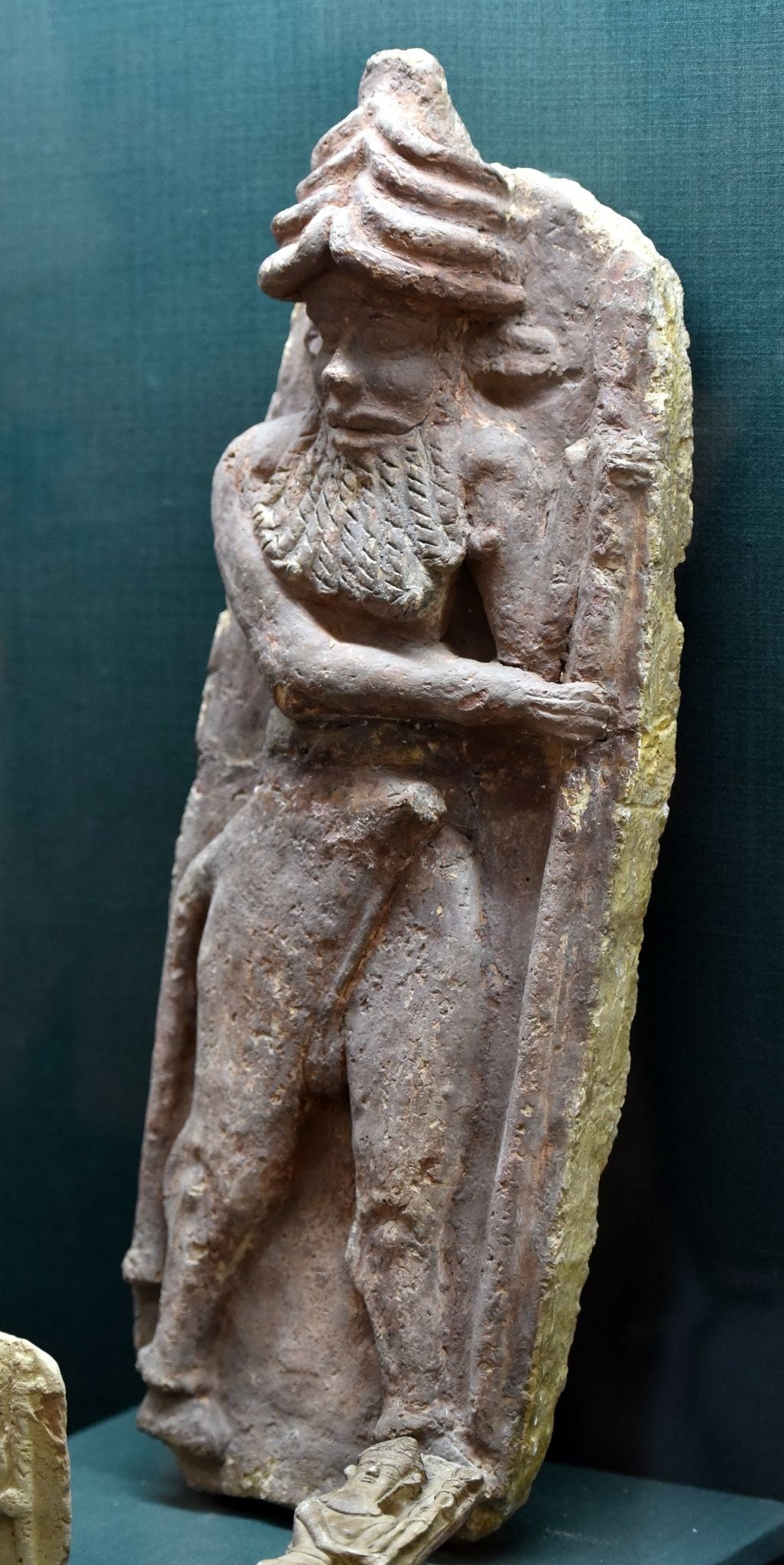

The first man is Enkidu, a wild man raised by animals. At the start of the Epic of Gilgamesh, he’s scaring the villagers with his wild man energy, so they hire the prostitute Shamhat to tame him1:
Shamhat unclutched her bosom, exposed her sex, and he took in her voluptuousness.
She was not restrained, but took his energy.
She spread out her robe and he lay upon her,
she performed for the primitive the task of womankind.
His lust groaned over her;
for six days and seven nights Enkidu stayed aroused,
and had intercourse with the harlot
until he was sated with her charms.
Shamhat is naked and hot, so Enkidu gets right on top of her and goes at it until he can no longer stand. In all of Sumerian epic poetry, you won’t see any depiction of sex that is any more tender than this. As Sumeriologist Jerrold S. Cooper puts it, “male sexuality is most elaborately expressed as rape: [...] nasty, brutish, and, often, repeated over and over.”2
The picture of sex we get here certainly isn’t nice, but it’s not terribly surprising. It would fit in quite well with modern pornography.
But here’s what is surprising: In Sumerian culture, this pornographic model of sex was understood to belong exclusively to the realm of prostitution or rape. What real couples did in their own bedrooms bore absolutely no resemblance to Enkidu and Shamhat.
Dumuzi
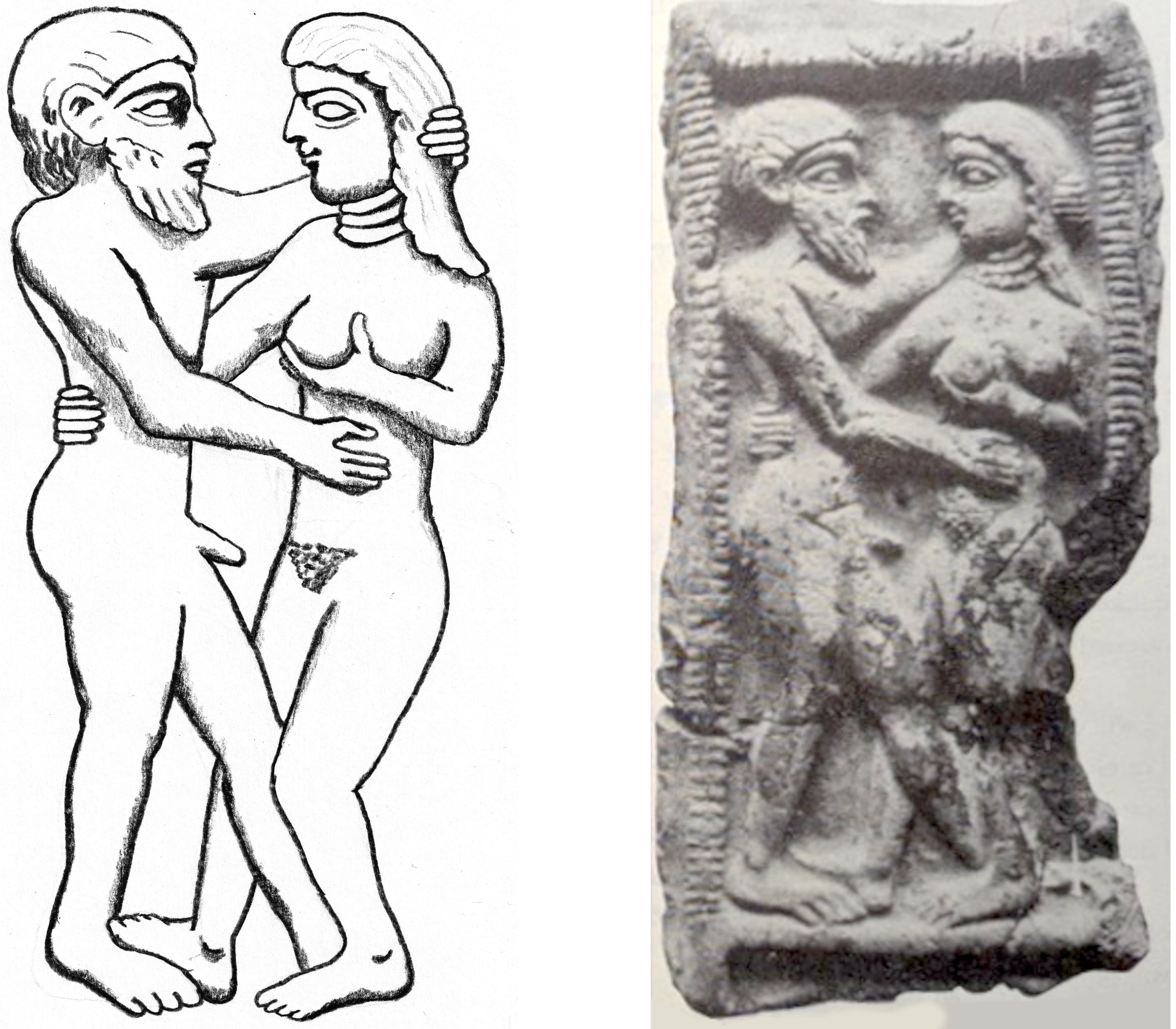
The archetype of the good lover in Sumerian culture was the shepherd king Dumuzi, the mythical first king of Sumeria. We find him in Sumerian erotic poetry, where sex has quite a different tone. Here’s his wife Innana speaking3:
When in his fair hands my loins shall have been shaped,
When the lord, lying by holy Inanna, the shepherd Dumuzi,
With milk and cream the lap shall have smoothed [?] ...
When on my vulva his hands he shall have laid,
When like his black boat, he shall have [?] it,
When like his narrow boat, he shall have brought life to it,
When on the bed he shall have caressed me,
Then I shall caress my lord, a sweet fate I shall decree for him,
I shall caress Shulgi, the faithful shepherd, a sweet fate I shall decree for him,
I shall caress his loins.
This sounds far more tender than the Enkidu passage, with much more attention to the woman’s experience. But at first reading, we might not realize how dramatically it defies some of our basic assumptions about sex.
Giving and receiving
People in my generation, who tend to equate “sex” with “intercourse,” tend to be confused by the account above. There seems to be lots of foreplay here, but where’s the actual sex? The answer is: what you see is it. He caresses her, she caresses him, and that’s the whole story.
That’s not an accident of the particular passage I picked. In Sumerian erotic poetry, we see a wide variety of sex acts, and, in particular, a wide variety of ways for the man to stimulate the woman, but we never see a couple having intercourse. We see, as Cooper puts it, “tender, sensuous sexuality [that] does not lead to conception, and privileges the female organ over the male.”4
On one level, that’s easy to explain. Children in this culture were intentionally spaced multiple years apart to support prolonged breastfeeding,5 and births were timed to happen in the spring when food was plentiful. How did they time births that precisely, without condoms or the pill? It seems likely that intercourse (“doing pregnancy”, as they called it) was that awkward thing you do every few years when you want to make a baby, and “real” sex looked very different.
But birth control alone doesn’t account for how different it looks. Not only is there no intercourse in Sumerian erotic poetry, there is nothing that even looks like intercourse. Amid the wide variety of sexual expression documented there, we find zero examples of either partner actively thrusting or rubbing their genitals against or into any part of the other’s body. One partner is always relaxed in the other’s embrace and passively receiving pleasure from the other. Never does one partner take pleasure from the other’s body, or use the other’s body for their own pleasure.
To me this seems nuts. Isn’t the basic content of sexual desire a feeling of “wow, it would feel great to put my body in contact with that body and move around”? No way did it simply not occur to ancient people that humping would feel good. If they categorically rejected any using of the partner’s body, if they put such of a severe restriction on their sexual expression, they must have had a compelling reason for it.
Taking turns
There is also a second, related oddity we can note. In this passage, and universally throughout Sumerian erotic poetry, the lovers take turns. They start with the man giving and the woman receiving until she is totally satisfied; then he relaxes back into her embrace and the roles reverse. In some cases, he is depicted as being so caught up in her experience that when she is done, he just wants to hold her and savor the moment, and it’s up to her to remind him that, hey, it’s your turn.
This may seem even more nuts to many of us. On the most basic level, how can that even work for the man? It seems like he will either be struggling terribly to hold himself back, or just outright bored. The ideal many in our culture strive for is simultaneous orgasms, and that’s already considered a challenge for the man!
To the Sumerians, what made sex feel most mutual wasn’t both getting there at the same time, but allowing both partners to devote their full attention to the woman’s experience, and then both devote their full attention to the man’s.
Attention
Attention is, in fact, given extraordinary emphasis in Sumerian lovemaking. The side-by-side posture shown in the tablet above — described as “his left hand under my head and his right hand caressing me” — carried not so much a sense of “hot and sexy” as of focused attention.
Earlier Innana asks Dumuzi to swear an oath to her:
For as long as you live you shall take an oath for me.
You shall take an oath for me that you will not touch another.
You shall take an oath for me that you will not [?] your head on anyone else.
[...]
You are to place your right hand on my vulva
while your left hand rests on my head,
bringing your mouth close to my mouth,
and taking my lips in your mouth:
thus you shall take an oath for me.
This is the oath of women, my brother of the beautiful eyes.
Notice that they are not simply kissing. Her lips are closed, and he is exploring them with his mouth. What is going on? If you think about how babies explore their world — grabbing things with their hands and putting them in their mouths — you can appreciate that she is asking him to fill his entire sensory world with her. Then she knows that he is fully intent on her and attentive to his oath.
But here’s the thing. If you saw a naked man with his hand on a naked woman’s vulva, would you assume he was fully relaxed, present, and attentive to her? Or would you, rather, assume that his heart was pounding and he was racing ahead in his mind to what he wanted to do next, and willing to say anything at all just to get there?
We seem to think that the only options for the man’s mental state during sex are “checked out” or “desperate to get some.” Not present at all, or present only to a hot body. A standard piece of advice to men on how to slow themselves down during sex is to take their mind away to something boring like work or baseball. The Sumerians somehow learned to occupy a third state: deeply present and attentive, but in a relaxed and non-urgent way.
We may experience this sort of absorbed attention when we get caught up in the performance of a gymnast or figure skater, or get so swept up in the plot of a book that we are momentarily disoriented when we put it down and find ourselves in our own house. But how could that sort of identification with someone else’s experience be possible in a situation as personally compelling as sex?
Invitation
While we’re looking at the lovers’ posture, let’s note one more thing. In the clay tablet above, the woman is cupping her left hand under her breast, to make it easier for him to kiss or caress. It’s a gesture of invitation, a gesture that is receptive of touch. And it was a gesture that must have been seen as highly significant, because it appears consistently in human erotic art across tens of thousands of years of history, and across the entire geographic span of ancient humanity.
My wild theory is that in ancient culture, maybe this was the standard “opening move” of sex. That if you were snuggling with your wife and she rolled onto her back and cupped her breast like that, you thought, “oh, wow, I think it’s happening tonight!”
Obviously there’s no way to prove that, but it does jive with a definite observation we can make about Sumerian erotic poetry: one hundred percent of the time, it is the woman who initiates. The one exception, and it’s definitely an exception that proves the rule, is a motif where the man knocks on her door, and she then tells him that she’s taking a bath, doing her hair, putting on her makeup, and so on, and so on, until finally, in her own time, she says “Come in, my man, come in!”
We can chalk this up as another baffling attribute of Sumerian sex. Because in American culture, in 70% of couples it is the man who usually or always initiates sex, and in only 15% is it the woman.
What’s going on here?
There is actually a simple explanation for why the Sumerians chose a form of sex that to us looks weird, stilted, and logistically impossible. In our culture, “great sex” is exciting, breathless, urgent, desperate. We pursue hotness as our ideal. We even talk about “spicing up” our love lives, or “keeping the flame alive.”
The Sumerians did not pursue hotness. They avoided it at all costs.
Recall from the last post that “hotness” is an instinctive response to the presence of a body that is available for sex. It’s the feeling of lust, the “make that happen right now” response to what is, for most animals, a once-a-year opportunity to pass on our genes. But hotness depersonalizes sex. You can’t be with a beloved person and a hot body at the same time.
In Dumuzi-style sex, pleasure is never something you can take, and your lover’s body is never something you can use. You receive pleasure passively as you relax in their embrace. And so the “hotness” response is never triggered. Sex is not fueled by lust.
This is utterly contrary to all our assumptions about sex. It’s as if, in our culture, we want sex to be a noisy party where everyone is having so much fun that you can’t hear what anyone is saying. And the Sumerians want it to be like a deep, intimate conversation. We try to pump up the noise as high as we can. They try to get rid of the noise to make room for the real need that actually draws us together sexually: the need for attachment and human connection.
The Sumerians pursued hotness only in one situation: the once-in-a-few-years bouts of “doing pregnancy.” When the man, used to turn-taking sex, now had to keep a hard erection long enough to get the job done, they actually had scripts for the woman to read to get him into Enkidu mode.6 Unsurprisingly, these scripts sound like they came straight from a porn film, cuing sexual availability and nothing else.
This is another exception that proves the rule. Sumerians knew exactly what sort of talk gets a man’s heart rate elevated. They understood the nature of hotness. And understanding it — as we do not — they banished it from their erotic world.
An innocent sexuality
In contrast to “hot sex,” I think we should call this Sumerian model “warm sex:” tender, unhurried, driven by the craving for human connection. If our culture could embrace “warm” sexuality, the effects would reach far outside the bedroom. Jerrold S. Cooper tells us:
Let me close by noting that despite the dominance of patriarchy, there is not a lot of evidence for misogyny in ancient Mesopotamia. [...] Sexual prowess and sexual aggression were never components of Mesopotamian masculinity; neither male deities nor kings are praised for their sexual performance. Examples of rape in Sumerian literature — I can't think of any in Akkadian — always end badly for the rapist.7
Virtually all kings of ancient Sumeria commissioned erotic poems depicting themselves as lovers in the model of Dumuzi. This is propaganda, yes, but isn’t it surprising which direction it goes? In our modern world, “taking and using” sexuality is often celebrated, or at least tolerated, as an attribute of a strong leader. And our “boys will be boys” acceptance of men chasing hotness hurts everyone.
Why are pornography and adultery so tempting to men? Because they are pursuing hotness. Why do rape and prostitution and sexual abuse exist? Because men are pursuing hotness. Why are men so compulsively driven to sex and yet so unfulfilled by it? Because hotness always, at the moment you grab hold of it, proves empty and meaningless.
In the previous post, I told you how, as a young man, I was afraid to be a sexual person because male sexuality has done such harm in the world. Innana and Dumuzi show us that it can instead be something that builds connection, something that feeds our craving for attachment. This is a sexuality we can embrace with joy, a sexuality that draws us into greater humanity, a sexuality that can heal our world. This is sex as God created it to be.
But unfortunately it’s not sex as it exists today. In the next post, I will tell you about how warm sex disappeared from the world, and about A Desperate Plea to save it.
The Epic of Gilgamesh, Tablet I, tr. Maureen Gallery Kovacs
tr. Samuel Noah Kramer, The Sacred Marriage Rite, p. 63. The [?]’s are places where a word is missing or damaged on the clay tablet.
See Katharina Rebay-Salisbury, Prehistoric child spacing.
“We know what excited men sexually in ancient Mesopotamia, because we have […] texts whose explicit function was to stimulate erections [by] verbal arousal of the male by his female partner. (Jerrold S. Cooper, Gendered Sexuality in Sumerian love poetry). Cooper makes the mistake of equating “what excited men” with “what men wanted.” As Emily Nagoski reminds us, arousal is not wanting.