
Relinquishing control
Awe entices us to set aside our need for control and predictability

Part 4 of a study on the Song of Songs (part 1, part 2, part 3).
[A]we requires us to be overpowered by what’s before us. To even be undone if need be. We are moved. This is the fundamental difference between awe and lust. Lust is “power-over.” Awe requires being “overpowered.” Lust is actually a refusal to awe. Because awe requires a person be voluntarily power-less. Lust demands to stay in control. Awe accepts I will be changed.
Sam Jolman, No, This is Not Permission To Lust
I interacted with a human being today.
On the subway, my youngest pinched his hand badly in the seat. The woman sitting next to us sprang into action, digging into her bag looking for a bandaid, and then, once we figured out that he wasn’t bleeding, a cold soda for him to hold against the bruise. She gave him a squishy ball to cheer him up, and when he politely offered it back to her before we got off the train, she told him he could keep it.
This simple interaction colored our whole morning. By the time he was telling the story to mommy, there was a blood blister on his hand but the pain was forgotten in the wonder of “and she gave me a ball to keep!”
Unexpected human interactions like this are startling and delightful. Even something as simple as smiling at a stranger on the street and getting a smile back causes a rush of happiness for most of us. And yet, we modern American are conditioned to avoid such interactions. To be not people but roles: customer and cashier, worker and coworker, teacher and student.
Roles are alluring because they give us a sense of predictability and control. Knowing the right way to act, even if the role we are playing is a victim to a bully, feels safer than the sheer vulnerability of showing up as a full human being. Even in friendly spaces like church, we often show up as the role of “happy Christian” rather than as ourselves. To show up as a human being means forfeiting our sense of control over the interaction.
Showing up as a human being is also central to the sexuality of the Song of Songs. As I explained earlier in this series, the ancient Mesopotamian ideal of sex was more like a deep conversation than a wild party.
The various constraints they put on sex form a coherent strategy to avoid hotness, the make-that-happen-right-now imperative of our reproductive instincts. But a mere change in technique doesn’t explain the attentive presence, the sense of being immersed in the other’s experience that we see in their poetry. Replacing the role of “male sex machine” with the role of “tender, attentive lover” isn’t enough to get there. If we are to be genuinely naked together, our roles must be stripped away as well.
The Song of Songs will show us how to do that.
Hot or not?
Let’s look back at the “good sex” scene in the Song of Songs. As soon as the couple are alone in her bedroom, the man pauses to simply see the woman:
How beautiful you are, my darling!
    Oh, how beautiful!
Your eyes behind your veil are doves.
    Your hair is like a flock of goats
    descending from the hills of Gilead.
[...]
Your breasts are like two fawns,
    like twin fawns of a gazelle
    that browse among the lilies.
Until the day breaks
    and the shadows flee,
I will go to the mountain of myrrh
    and to the hill of incense.
You are altogether beautiful, my darling;
    there is no flaw in you.
Song of Songs 4:1,5-7 (New International Version)
Sounds pretty hot, huh? Or… is it?
Listen carefully to the tone here. “Your breasts are like two fawns, like twin fawns of a gazelle.” If we’re not paying close attention, we just hear “breasts” and think, “ooh, sexy!” But, baby fawns? How do we actually react when we chance upon baby animals? Leap out and grab them? Or catch our breath and fall into stillness, recognizing that we are seeing something special and intimate?
There’s a resounding sense of “wow” in these lyrics, but it isn’t the “wow” you might hear in a modern song: “Wow, you’re hot and I’m desperate to get it on with you.” When he concludes that “there is no flaw in you,” he isn’t saying “all your body parts rate five out of five for sexual utility.” This is a resounding yes to her entire being. It is awe.
And awe actually defuses lust.
Awe is more compelling than lust
Hotness-driven sex is suffocatingly single-minded. Lust literally feels smothering. I call it “disembodied penis mode” — my self-awareness shrinks to one part of my body, floating around looking for somewhere to shove into. My wife is reduced to an object.
But something extraordinary happens if I make myself stop and see her. It feels like swimming up from underwater. I break through the surface back into the world of light and sound, and I’m startled into stillness by the wonder of finding another human being there. And suddenly, overwhelmed with awe, it is enough to simply be together, with no goal in sight.
Sam Jolman, who has written extensively about awe as the center of healthy sexuality,1 tells a similar story:
A man wrote to me recently, “I tried what you said in your book and it messed me up.” [...] So right in the middle of using porn, he decided to pause and let himself take in the beauty of the performers. And it ruined the moment. He couldn’t finish and simply had to just shut his computer.2
That story shocks and inspires me.
Porn is the crystallized essence of “sexually available body.” It is built on the assumption that the instinct to take advantage of an available body is the most fundamental force in the male psyche. Trillions of dollars have been spent honing porn’s compulsive power. And yet simply seeing porn with a desire to find beauty in it is enough to shatter that power.
Crazy, yes?
Awe and lust are incompatible, and awe is more compelling than lust. When I think of this in light of the raw terror with which many Christians regard the supposedly irresistible allure of sexual temptation, I can’t help but be reminded of the story in 2 Kings 6 where Elisha’s servant is terrified by the army besieging their city — until God opens his eyes and he sees the chariots of fire arrayed atop the hills between them. Yes, a sexy body is alluring, but the presence of another human being is even more compelling.
Surely God has made us for connection.
Awe is a practice we can learn
Now, when I suggest that we should choose awe over lust, some of you might be confused. Is awe something we can choose? We tend to think of awe as a rare experience that catches us by surprise: a spectacular sunset, a breathtaking view of a mountain.
I didn’t learn how to choose awe until a few years ago. During the pandemic, everything shut down, including public transit. And our family has no car. So, I would push my kids in the stroller to the same park every day, where they would dig the same hole in the same muddy stream every day. For three hours.
Mud is infinitely fascinating to kids, but I thought I was going to go crazy watching them. So I started drawing things — mostly trees, because they would hold still long enough for me to get them on paper.
When I told my wife I was trying to learn to draw, she gave me a book by artist Frederick Franck. He writes that learning to draw is really about learning to see:
Millions of people, unseeing, joyless, bluster through life in their half sleep, hitting, kicking, and killing what they have barely perceived. They have never learned to see, or they have forgotten that man has eyes to see, to experience. [...]
The purpose of “looking” is to survive, to cope, to manipulate, to discern what is useful, agreeable, or threatening to the Me, what enhances or diminishes the Me. This we are trained to do from our first day.
When, on the other hand, I see – suddenly I am all eyes, I forget this Me, am liberated from it and dive into the reality of what confronts me, become part of it, participate in it. I no longer label, no longer choose.3
“Diving into the reality” of the tree in front of me, being totally absorbed in its particularness, is the same experience that Sam Jolman calls “awe.” It’s another form of relinquishing control: allowing something to simply be, and appreciating it for what it is, rather than valuing it for what it offers to me.
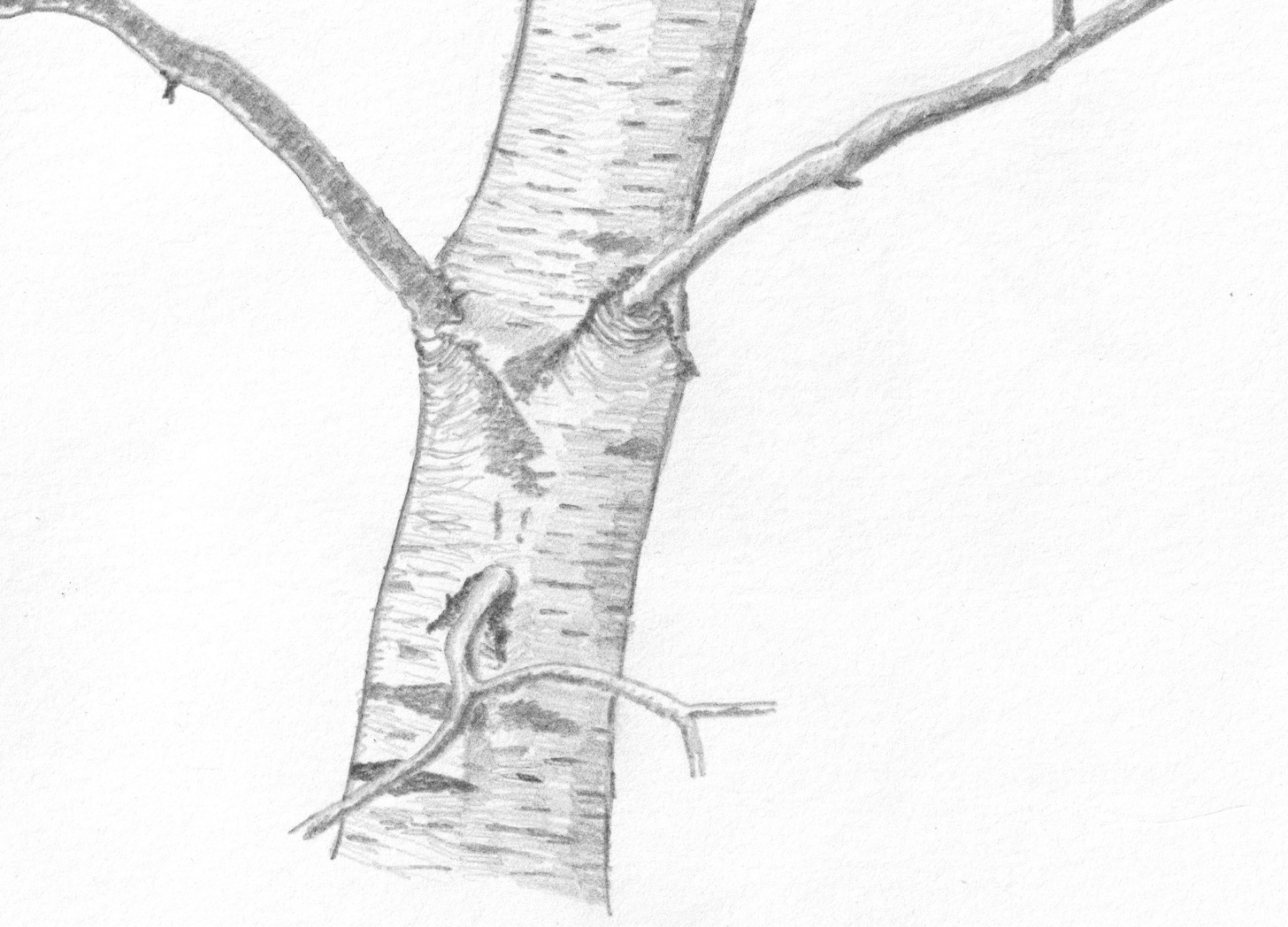
When I read Sam Jolman’s book, I realized that I already knew how to switch tracks into the “awe” mode he was describing, by seeing in the careful way I would when I’m drawing something. Not just looking and labeling, but seeing details: that shape is concave, that convex; these line join, these split. This way of seeing isn’t a rare experience that catches you by surprise; it’s a skill anyone can easily learn, and a choice anyone can make from moment to moment. And making that choice during sex transforms it in more ways than one.
A different path
A very funny and talented sex educator, in a mandatory event during my freshman college orientation, showed us a chart of the “arousal cycle,” the pattern of how sexual excitement builds over time during sex. Women, he joked, shouldn’t be jealous of the fact that men could go from zero to sixty in mere minutes. It was men who ought to be jealous, because the women’s line goes up much higher and stays there much longer:
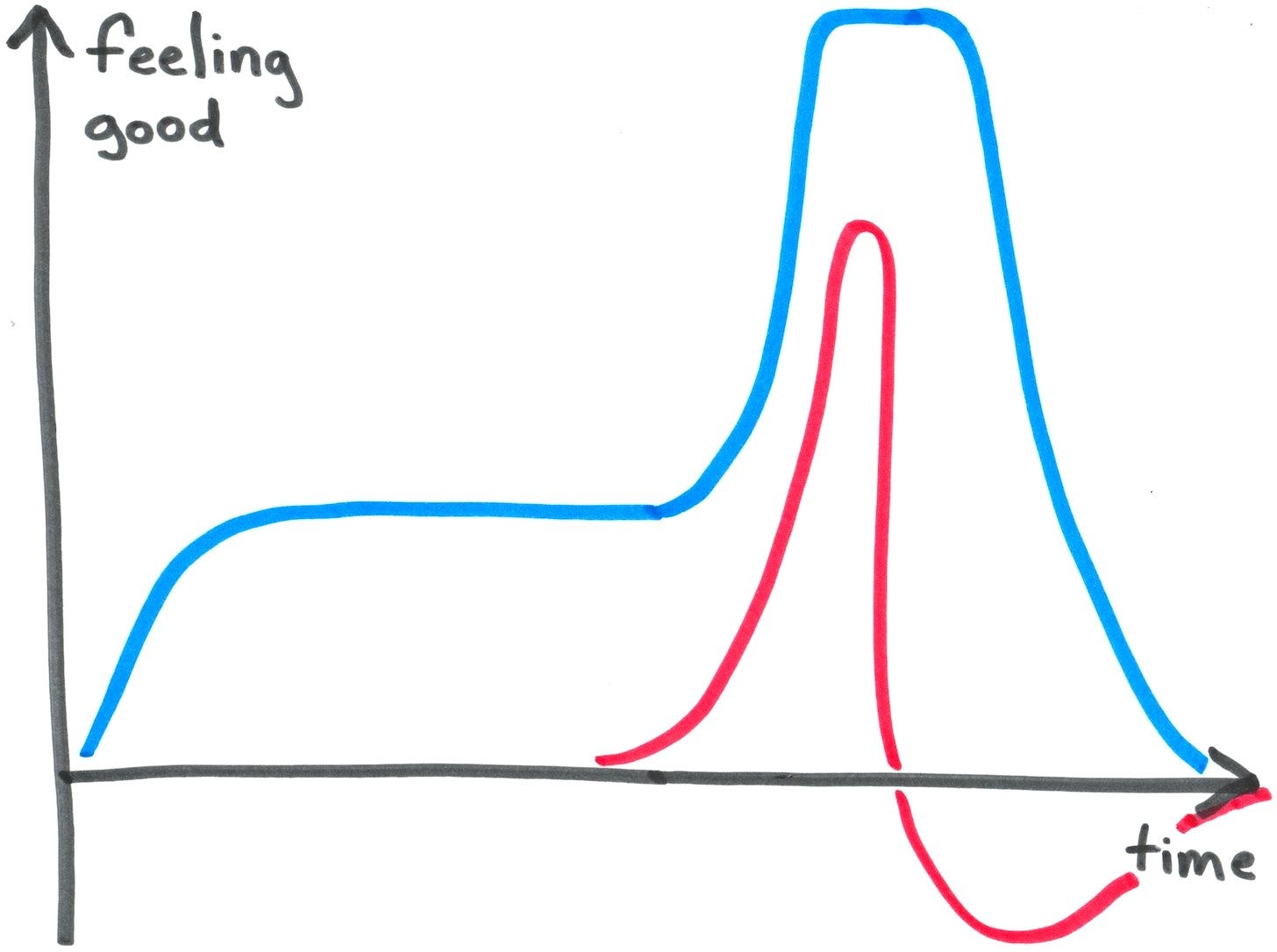
That was back in 2000. We’ve learned a bit about sex since then. It turns out his chart was correct, but he had mislabeled the lines. The blue line is what “normal” arousal is supposed to look like, for both men and women. The red line is what it happens when sex is driven by lust.
Lust — hotness — is a shortcut to orgasm. It’s our reproductive instincts taking over and trying to make ejaculation happen as quickly, reliably, and frequently as possible. But we pay a price for following that path. We forfeit not only the sense of human connection, but much of the enjoyment of sex itself.4 And for most men, this is the only path we know to follow.
Writers like Sheila Wray Gregoire lament the fact that some women have never been able to experience an orgasm. The shocking fact is that most men haven’t experienced what orgasm is supposed to be either. We just know how to easily hack our way to a reasonable facsimile. One that feels pretty good, but also strangely disappointing.
This suggests two things to me. First, it explains, finally, why Sumerian men chose this path even though it’s not as easy as leveraging “hotness” to get off quickly and reliably. And second, I just have to laugh, because surely we were made for this. Sex built around connection isn’t a struggle men should grudgingly bear because it works well for their wife. It’s better in every way, for both partners.
It’s also terrifying
Now, to any man who heard that and said, “Whoa, sign me up!” I ought to offer one warning. Switching to the “blue line” mode of sex is also absolutely terrifying.
A character in Emily Nagoski’s sex ed book describes the experience like this:
It was like being way out in the center of the ocean, when I usually just surf on the shore. Bigger and slower... and scarier, too, in some ways. I was all the way open. I had to let go of all control.5
For many of us men, the way sex has always worked is that lust just takes hold of us and drives us right to the finish line. So when lust is no longer running the show, it seems like something has gone horribly wrong. It’s like slipping the chain on your bicycle just as you’re starting up a hill — suddenly you’re pedaling like mad and nothing is happening. For many of us men, sex has never required any sort of progression, any warming up. We’ve never learned to listen to our bodies to find out where and how we want to be touched.
And we’ve quite likely never learned to communicate that to our partners either. Most men are used to taking an entirely active role in sex, and if we communicate at all it is only to ask permission for things we want to do with our partner’s body. To take a receptive role — and to do it with no map at all — feels incredibly vulnerable.
In that vulnerability is a sweetness that we can learn to welcome and cherish. Because it is only when we are vulnerable, only when we are not in control, that human connection is possible.
It’s called shalom
The Bible has a word for this terrifying step of relinquishing control and allowing others to simply be on their own terms. It’s called shalom. And it’s at the very center of what it means to live a life of faith.
The Bible often translates “shalom” as “peace.” Not in the sense of “no conflict,” but in the sense of “no storm can shake my inmost calm.” The secret of shalom is that choosing to relinquish control is terrifying, but living without a need for control is liberating. People who need to be in control live in fear. Forfeiting control means letting go of the stress and anxiety that come with needing power over what happens.
One “shalom” choice my family has made is that we don’t own a car. We rely on public transit instead of having the convenience — the control — of being able to get ourselves wherever we want to go, whenever we want. But what did we really give up?
It turns out that city traffic is the same whether you’re driving your own car or riding a bus. But since I’m not driving — not in control — I don’t have to rage against the traffic and yell at the kids fighting in the back seat. Instead, we all sit together and I read a book aloud. We get lost in the story. We are content. We have no illusion that it is in our power to get to our destination any faster.
We apply shalom to parenting when we decide to trust that our children are good, loving people; when we stop insisting on obedience and trust that their resistance and outbursts are the product of a good heart trying to work through hurt and frustration. We choose shalom financially when we restrict ourselves to a comfortable level of “enough” and give the rest away, not hoarding in fear of the future or grasping at consumption that brings no fulfillment. If we could apply shalom to world politics, we could have a world of secure, peaceful countries prospering together, rather than wasting precious lives and resources in stupid, grasping wars.
And shalom, in our relationship to God, is the central message of Christianity. We don’t have to believe the right things or behave the right way to earn God’s love. That’s the way of control — trying to put faith within our own power. And it’s also the way of fear: fear that we will never measure up. Jesus asks us to surrender the struggle for our own righteousness, and relax instead into God’s wonderful acceptance.
And what then? If there’s nothing we can do to make God love and accept us, what is there left to do in this life? Simply this: choosing shalom. In every part of our lives, we have to let go of fear and the need for control. Because every time we do that, we are living a little more in the Kingdom of God.
My hope for this series of posts is that it has given a picture of how we might do that in the area of sexuality.
Particularly in The Sex Talk You Never Got, which contains the most beautiful and inspiring writing about the heart of male sexuality that I have ever read.
Sam Jolman, How Men Objectify Themselves
The Zen of Seeing, p. 4
In the “Orgasm” chapter of Come As You Are, Emily Nagoski gives a recipe for explosively awesome sex: taking turns, turning off the urgency, and a receptive rather than active posture. In other words, exactly what we see in Sumerian erotic poetry.
Come As You Are, p. 286